

Do You Have An Eternal Perspective?

eternal perspective

This post on having an eternal perspective is the first in a series of posts that come from the material I recently used in a presentation I made to a small group of Christian business owners and leaders in Chandigarh, India.

The focus of this material is also the focus of this blog – God’s call for us to run our businesses as a platform for Christian ministry. Hopefully, after reading this series, you will agree that it is God’s will that we run His businesses as stewards with an eternal perspective. You should also have a better understanding of what this looks like in today’s marketplace.

Focus on Scripture

For the next minute or two, I want you to forget about work, business, etc. and concentrate instead on the Scripture I will highlight below. This post will have the greatest impact on you if you will read each passage in full as you go. If you need to come back to this later to do that, so be it.

However, if you are like me, you will likely never come back to this. You will put it off repeatedly and then finally delete it. If that is the case, please stop now and take the time to do it right.

We Must Have An Eternal Perspective

Let’s start with these passages below. You can follow along in your Bible or just click on the Scripture links.

  1. Psalm 39:5
  2. Psalm 144:3-4
  3. Job 14:1-2

From these verses, it is crystal clear that as humans, our life is extremely short. The Psalmist calls our life a vapor. Job calls it a shadow that does not last.

Question # 1 – Do you TRULY BELIEVE that our lives are short and not guaranteed?

Surviving The Fire

Next, let’s read the following passages:

  1. 1 Corinthians 3:11-15
  2. Matthew 6:19

It is easy to see from these verses that a day is coming when everything on earth will be tested by fire. Only those things we have done that survive this fire will bring us reward. Everything else will burn.

Even between now and that day, we can expect rust, moths, and thieves to destroy or steal anything temporary we possess. Nothing we think we own today is guaranteed to survive intact for our entire lives, much less for eternity. It is all subject to the elements or theft.

Question # 2 – Do you TRULY BELIEVE that all of your earthly possessions will deteriorate and eventually be destroyed on this side of eternity?

Laying Up Treasure

Finally, take a look at these verses:

  1. Matthew 6:20-21
  2. 1 Timothy 6:17-19
  3. 1 Corinthians 3:14

In these verses, God promises us that we can store treasure in heaven that will survive the fire. He promises that, in effect, we can make deposits into an eternal savings account for future use! The only requirement is that we understand the difference between temporal and eternal value.

Question # 3 – Do you TRULY BELIEVE that we can store treasure in heaven through our actions here on earth?

Summing Up The Eternal Perspective

I want you to read back over the three questions listed above. If you answered any of these questions with a “No,” then I recommend you do further study on the infallibility of Scripture. You are certainly welcome to disagree, but, if so, the rest of this post will pretty much be meaningless to you.

IF, and I mean only IF, you answered “Yes” to all three of these questions, then I want you to answer two final questions.

Final Question #1 – Does your personal life (decisions, actions, focus) reflect the fact that you believe these three truths?

Final Question #2 – Does your business life (decisions, actions, focus) reflect the fact that you believe these three truths?

For a great visual illustration of this idea, watch this Francis Chan video on eternal perspective:
My First International Christian Business Conference!

Christian business conference

Just reading the title of this post makes me feel weird! I am not that guy in my mind. I am not someone that gets the opportunity to teach a group of Christians one third of the way around the world. I have so much to learn myself…I could not possibly be able to teach anyone, right? Even if the subject of the conference is Christian Business, something near and dear to my heart, I do not feel qualified.

Regardless of how qualified I feel, that is exactly what I had the opportunity to do a couple of weekends ago. I was given the opportunity to teach a small group of Christians in Chandigarh, India about Christian business and taking their faith into the marketplace. Before I give you more details about the event itself, let me tell you a little about how it began.

My Passion

I started this blog only eight months ago. I started from scratch. I did not have a platform ahead of time. I did not have a name in the Christian business world beyond my fairly small circle of influence. All I had was a passion welling up inside of me that had to get out.

This passion is for Christian business – using our businesses and/or leadership positions to do ministry for eternal impact in the business world. This passion is what has driven me to attempt to run my business with an eternal perspective for the past eight years. This passion has brought disappointment and victory, but it has also brought opportunities I never would have imagined before.

First Contact

After several months of blogging about Christian business, I received a comment on one of my posts from Pastor Rajeev in India. We exchanged emails and began communicating about our similar passions.

Rajeev mentioned another contact here in the U.S. named Scott Pitman. Scott is actually a car dealer like myself! He owns a very successful Suzuki dealership in Wichita, KS. More than that, Scott is a prime example of a Christian using his business as a platform for ministry. Check out his foundation’s website (Walking in the Reign) to learn more about what he is doing in Wichita as well as Haiti and India!

The Invitation!

Anyway, I talked to Scott about Rajeev and got some information on the work Rajeev has been doing with Scott’s help. I continued communicating with Rajeev about his ministry and mine. One day, he asked me if I used Skype.

I told him I did. He went on to ask if I would be interested in using Skype to teach some of the business people and professionals in his church about Christian business and marketplace ministry. I was shocked at first (reread the first paragraph of this post!), but then I realized God was certainly working in this. There was no other way that someone like me would get this opportunity – except by God!

My Fears

We made necessary preparations, including a practice run with Skype, and then set the date. The closer the date got, the more nervous I got! Surely something would happen and it would get canceled or postponed…maybe they find out I am not really qualified! More likely, they will run across someone else with better skills and more knowledge. Maybe I should even find someone for them and suggest they make the switch!

Maybe you would not have thought all of these things, but I did. I must have asked Rajeev ten times to give me a better feel for the cultural differences, his expectations, the make-up of the audience, etc. I wanted to know more so I could feel more secure. Unfortunately (or not), he just kept saying that I would be fine and that God would take care of it.

Successful Christian Business Conference!

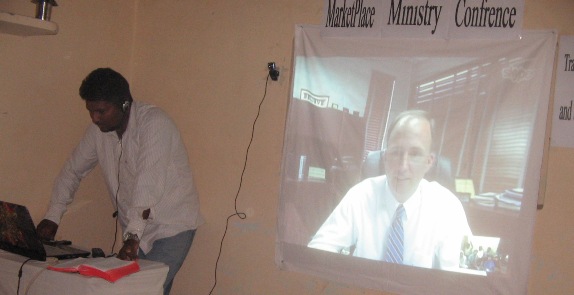
Finally, the day came and the conference went without a hitch…that is if you ignore the 20+ times our internet connection failed! Even so, it really did go smoothly. We were prepared for the hiccups and God paved the way for a smooth presentation (with Rajeev translating). It was truly a remarkable experience.

Christian business conference

Audience in India in prayer.

I cannot explain the excitement that was pulsing through me as I sat in my office in Georgia watching a group almost 8,000 miles away in India sit attentively listening to what I had to say about running a Christian business. The teaching lasted three hours straight (1.5 hours of material and the same amount of time spent in translating!). They never took a break, but sat quietly on the floor soaking it up.

Future Opportunities?

They ended the session with a couple of questions, including the request for further teaching. Rajeev also has another church or two that wants to do the same session in their nearby churches! I honestly do not have any idea where this is headed. Nor do I need to! I am much more inclined to just trust God at this point and see where He takes it!

My Take Aways

Here are some take aways I have from this experience:

  1. Don’t underestimate God. He can do more than I can imagine. (Ephesians 3:20-21)
  2. These things do not depend on my ability, but on His will. (Proverbs 21:31)
  3. Learn and grow as I wait on Him. He will use the knowledge I gain. (Psalm 37:34)
  4. Moses did not get off the hook just because he felt unqualified. (Exodus 4:1-13)
  5. Be faithful in the small things and He will give me bigger ones. (Matthew 25:21)
  6. Relax and trust Him. Worrying is not productive. (Matthew 6:27)

What is God preparing you to do?

Are you being patiently faithful?

Do you see a take away I missed?

Christian Business: My All-Time Top 10 Posts

I have not done a Top 10 post in a while, so I thought I would catch up. The following Christian business posts are my most popular so far, since the beginning of the blog! I hope you will check out the ones you don’t recognize and let me know what you think!

Christian business

Top 10 Christian Business Posts

1. Why I Decided To Walk Away From The Family Business…
This one is close to my heart because it is truly what started all of this. Interestingly enough, this post received more than three times as much traffic as #2. It has been the top post every time I have ranked them. It was certainly a turning point in my life – one I will never forget.

2. Pursue The Gifts You Have, Not The Ones You Want!
This is a great post about embracing our God-given gifts. This post received more comments than any of the others on this list.

3. Reason 2 of 5 To Run Your Business According To Your Faith
In this post, I look at how the Greatest Commandment(s) relate to our business purposes. This really hits at the core of what drives my efforts in business.

4. 10 Warning Signs You Are Not A Good Leader (Part 1)
I think we have all tripped over one or more of these at one time or another! Make sure to read “Part 2” as well! How many did you recognize?

5. Taking Action: Owners Manual For Life!
Here I describe one of the various methods our company employs to do ministry in the course of doing business. I also explained how I was heeding my own advice to just take action!

6. Why Acknowledge Christ In Christmas?
As a result of a friend sharing a video with me, I ran a Christ-centered TV ad leading up to Christmas. I posted about this video and the bigger issue of acknowledging Christ in Christmas.

7. Is Lack Of Excellence Excusable In Christian Business?
Too many Christian business people think mediocrity is excusable because they get a pass for being a Christian. Too many consumers get nervous when they find a Christian business because they are sure the service or product will be poor. Is this really acceptable?

8. How To Create A Life Plan Document
If you do not have one, in any shape or form, then you need to read this post. You are missing out on some serious impact and influence without one.

9. Reconcile And Forgive Immediately!
This was the fifth post in a series on character issues for leaders. I confessed my own struggles in this area as well.

10. Do You Have A Strategic Plan…For Ministry?
Just like #8, if you do not have one, you need it. We often make strategic plans for our businesses, but very few do the same for their ministry impact. Read this post and get started!

Did you see a post you missed?

What was your favorite? Why?

If you have a blog, what has been your most popular post? Sound off!

What Is A Christian Business?

Christian businessRecently, I have had multiple opportunities to answer the question, “What is a Christian business?” In fact, in a couple of days I will have my very first opportunity to teach an conference of business owners and professionals about taking their faith to their workplace.

Do you want to know the cool thing about this opportunity? The audience will be in India and we will be communicating via Skype!

Christian Business Defined?

In preparation for this conference, I have been working on my definition of a Christian business. While I am not an expert, I have spent the past eight years trying to answer the question and live it out. I have read what the Bible has to say about it, as well as many books that reference the Bible. I have learned from others that are living their faith through their businesses. I have also learned from my own mistakes and disappointments.

Rather than try to relay everything I have learned about defining Christian business (and taking the next several hours of your time!), I will try to give you the basics. I do not pretend that this is an exhaustive definition. Nor do I claim that I am the authority and cannot be questioned. I am simply a disciple that is learning as I go. This is what I have so far:

[box]

6 Characteristics of a Christian Business

1. God owns the earth and everything in it.

    This includes all animals, all plants, and even all businesses. In my opinion, the first step of a Christian business is to acknowledge this fact and submit the leadership of the business to God’s direction.

2. God’s economy operates from an eternal perspective.

    God’s economy does not operate from a 30 day picture (or quarterly or annual either). Therefore, a Christian business operates from an eternal perspective – choosing eternal impact over financial results. Obviously, no business can exist by ignoring financial results, but by operating on God’s principles first, both can be achieved.

3. Christian business does not guarantee prosperity.

    Despite TV preachers telling you otherwise, dedicating your business to God will not guarantee you financial success. Though God promises to honor our efforts if we dedicate them to Him (Psalm 37:5-6), He does not say when this will happen. His time frame is not ours. We may expect our reward while we are honoring Him, but He may not bring it to life for 100 years. We honor Him for who He is, not for what it will bring us.

4. The mission of the Christian business lines up with Scripture.

    The Greatest Commandment (Matt. 22:37-40) and the Great Commission (Matt. 28:19-20) are commands, not suggestions. Therefore, I believe the Christian business should have a mission that reflects these commands.

5. A Christian business exists and operates in the “world.”

    It employs believers and non-believers alike. It ministers to both, as well as customers and the community, in the normal course of doing business. This ministry takes on a variety of looks!

6. A Christian business will fulfill us.

    Quite simply, we are designed to be fulfilled through our relationship with God. Period. If we try to separate our work from that relationship in the hopes that we will get a different, material fulfillment, then we are sadly mistaken. Read Ecclesiastes for more on this. On the other hand, even the most menial work, if done unto God, will bring fulfillment we cannot imagine.

[/box]

To me, these are basic characteristics of a “Christian” business. I believe this can be done in a tasteful and practical way, without using a bullhorn (consider Chick-Fil-A). Of course, there are going to be pitfalls along the way. But in the end, I believe the fruit that is produced by this kind of business will survive the fire (1 Cor. 3:11-15).

What are your thoughts about these characteristics?

What would you add? What would you eliminate? Why?

How close is your business to exhibiting these characteristics?

Crisis – An Advisory Board In Action

advisory boardAs Christian business owners and leaders, we are virtually guaranteed to face a crisis in the course of doing business. In fact, the odds are we will face more than one.

Are You Prepared?

Depending on your experience, you may or not be prepared for it when it hits. If it is big enough, even your years of experience may not help. This is where the combined godly wisdom of a good advisory board is critical.

Advisory Board in Action

In a recent C12 advisory board meeting, one of the members shared the crisis he is currently facing in his business. His crisis was actually a conglomeration of several difficult issues involving family, business, and faith. To protect the innocent, I will not go into details!

The Crisis Defined

I will tell you that in all my years of business, I have not faced anything like this business owner is facing. It quickly became clear in the group that the same was true for the rest of the members. This situation was a doozy and had more hair on it than Bigfoot! Quite simply, there was no clear and easy solution.

It took the member 30-45 minutes to finally get all of the pertinent facts onto the table because he was so distraught over the situation. He bounced from issue to issue, trying to describe all the details. We were asking clarifying questions the whole time because he was so scattered in his thoughts and words. It was a painful effort just getting a clear picture of the whole situation.

Action Plan Established

From there, it was amazing to watch the minds of eight godly, Christian business owners jump into action. In a flurry of more questions, debate, and brainstorming, our advisory board group came up with a solid action plan for the member to execute.

Here are some of the advisory board contributions:

    1. Detailed the timeline for his action plan.

    2. Debated the best approach to each step of the plan.

    3. Outlined possible break downs in the plan and how to respond to them.

    4. Discussed the potential pitfalls to shortcutting various steps in the plan.

    5. Gave advice relating to legal issues he will need to further investigate.

    6. Tested our recommendations against Scripture throughout the process.

    7. Questioned him on various decisions he had made up to this point.

    8. Gave him contact info for key people that could meet various needs.

    9. Prayed over him and the whole situation – asking for wisdom, peace, strength, mercy, forgiveness, peace, and reconciliation for all parties involved.

Now Fully Prepared

At the end of the meeting, it was clear that the member was in better spirits and fully equipped to face the crisis head on. While, the tough time was still in front of him, he knew he was on the right path and had a solid game plan. He also knew that we would continue to pray for him through the process. That does a lot for one’s confidence.

Advisory Board Structure

I encourage you to contact C12 if you are interested in visiting a group meeting to get a feel for how it works. Of course, the C12 Advisory Board structure is not the only way to accomplish this process. In my conversation with Mark Cress a couple of weeks ago, he explained how his advisory board consisted of a unique blend of personalities and experience. This board is the actual Board of Directors for Corporate Chaplains of America (CCA).

Though there are some significant differences in the responsibilities of his board when compared to the C12 advisory board, the benefits discussed in this post are the same. An example of this is how the CCA board has played a critical role in creating Mark’s succession plan over the next several years. Their combined wisdom will ensure a smooth transition of leadership over CCA, as well as position the organization for significant growth in the future.

You Need An Advisory Board

The bottom line is that regardless of the size of your business, you need an advisory board. There are too many potential problems you could face that will require more wisdom and experience than you have. Whether you seek a paid advisory board or one that volunteers their time, you cannot afford to go it alone.

Consider these verses from Proverbs as your encouragement to get started:

Without guidance, people fall, but with many counselors there is deliverance.
-Proverbs 11:14

Plans fail when there is no counsel, but with many advisors they succeed.
-Proverbs 15:22

Finalize plans with counsel, and wage war with sound guidance.
-Proverbs 20:18

…wage war with sound guidance – victory comes with many counselors.
-Proverbs 24:6

Do you have similar access to the godly wisdom an advisory board offers?

What are some other benefits you have seen?

If not, when are you going to get started?

Christian Business: 7 Easy Ways To Integrate Faith And Work

Christian businessI am a strong believer in the great need for Christian business owners and leaders to begin integrating their Christian faith and their businesses. I do not think enough people are thinking this way, so I write this blog in an effort to get the message out.

As part of this effort, I often include practical ways to do ministry in the normal course of doing business. The following is a list of 7 easy ways to get started. Each item on this list is something we are already doing and is further described in separate post. The link to each post is included in each brief description. At the end of this list, I will tell you how to find another 101 ideas!

7 Easy Ways To Integrate Faith and Work

1. Christian mission statement

    This is so crucial that it really should be the first thing you do. A mission statement that acknowledges your business as a Christian business not only tells others what you are about, but also serves to keep you on track for years to come. Read more here – Mission Statement – Step 1 in a Strategic Ministry Plan.

2. Impact Fund

    Your employees will get into the giving spirit if you lead the way. Creating a fund that allows them to support their co-workers in times of need is a huge opportunity to lead. They will surprise you with their response! Read more here – How Could a Business Help with Employee Hardship?.

3. Gospels in the lounge

    You do not have to hit people over the head with the Gospel to spread it as a Christian business. Simply placing these simple Gospel messages in your customer areas is a great way to sow seeds. Let God do the rest. Read more here – Ministry Action: Gospels in the Lounge.

4. Employee Newsletter

    Communication is critical for any business. This is especially true for a Christian business. You can easily improve your company-wide communication through the use of a company newsletter. Using even the simplest of newsletters to convey a Biblical message or promote Christian values can bear fruit. Read more here – Advice from Coach Wooden.

5. Message at company gatherings

    Company gatherings, such as Christmas parties, can be an excellent opportunity for the Christian business owner or leader to reinforce the mission of the company. An easy way to do this is to carve out 10-15 minutes or so and tell a story or interesting illustration that conveys the Gospel message. While the first time may be uncomfortable, God will honor your efforts. Read more here – Christ and the Company Christmas Party.

6. Message to customers

    Different companies will have varying opportunities to share the Gospel with customers. For us, including a copy of the New Testament, with a cover that reads “Owner’s Manual For Life”, in the glove box of every car we sell seemed like an easy way to accomplish this. Read more here – Taking Action: Owner’s Manual for Life.

7. Chaplain program

Don’t Delay!

You should have no excuses to delay. Pick one or two ideas to get started, grab a couple of your key people to help, and lay out your plan. I promise you will not regret taking action!

Do you see any ideas you can implement immediately?

What can you add to the list?

What results have you seen from your efforts?

Have You Thought About Walking Away?

Walking AwayI made a new friend recently. During our conversation, he told me about his decision to walk away from a very successful business because he felt God calling him to something different. He did not know where God was calling him, but he knew he had to follow. I think you can draw inspiration from his story – whether you have ever considered walking away or not.

Mark Cress’ Story

In 1993, Mark Cress was part owner of an Inc. 500 company. At 37 years old, he was extremely successful and it appeared he had nothing but blue skies ahead. But then he started to realize that God was calling him to something else. Once he and his wife made the decision to follow God’s call, things changed rapidly. Within months, he was walking away. He had sold his business to the employees, sold his house on the lake, and enrolled in seminary. In less than a total of three years, he had started the organization that is now Corporate Chaplains of America.

Corporate Chaplains of America (CCA) now ministers to more than 800 different business locations. Those locations represent thousands of employees served on a weekly basis. Can you imagine the impact God is having through this organization?

My Story

As I listened to Mark tell his story, I saw a few clear parallels to my own story. At the same time, God sent us down different paths.

All of my life, I had been working toward taking over my family’s business, an automobile dealership group in Georgia. In 2001, I was General Manager of two of our seven locations. I planned to expand and take the company to new heights!  I had visions of grandeur and everything looked like it was headed that way.  But when I began spending time in God’s Word, I realized that everything I wanted and was working for was only temporal.  None of it would really matter in 1,000 years.

My Revelation

I realized I was only giving God the Christian requisite one day per week (actually, just Sunday morning) and an occasional Wednesday evening.  The rest of the time was spent trying to juggle my job in the car business and my family at home.  Even when I added the daily quiet times, God was still not the central focus of my life.  This was not the way He wanted it!

Searching For Answers

I began searching for answers.  If God wanted all of me, what would that look like?  I had heard of people getting “called” into full-time ministry, but I did not feel that call.  I knew of others, like Mark Cress, that were “called” into the mission field, but I did not feel that either.  What exactly was God asking me to do? What was I created to do?

Was I Walking Away?

To tell the truth, I did not have a clue!  I only knew I was not comfortable with the status quo and had to change it. I sat down with my father and explained that I was walking away from the business.  Because I was already in a significant leadership position within the company, I told him I did not want to do it effective immediately.  I wanted him to have time to replace me and make any other arrangements that may be necessary.  This would likely involve downsizing the business and could take a couple of years.

I did not feel God calling me to leave right away, only to let go and be prepared to walk away.  I had no idea where I was going or when.  I only knew I wanted to be spending more of my time working for God – whatever that entailed.

Called To Stay In The Business!

Fast forward eleven years, and I am still in the business! It was almost two years after that conversation with my father that God showed me where He wanted me. Though I thought I was walking away, He showed me that He had placed me in the position I currently held for a purpose and a season. He wanted me to do all I had envisioned in ministry, but He wanted me to do it through the business. As a good friend recently told me, God wanted me in the car ministry!

So that is exactly what I am attempting to do. I have said it many times – I do not have it figured out. Yet I keep showing up. I am determined to allow God to have the eternal impact He desires, through this business. I am only the steward of this business for now. Until He changes my direction, that is the role I will play.

Eternal Impact Either Way

See, Mark Cress followed God’s plan and he is enjoying the fruit of that decision. There is incredible eternal impact coming from his decision to step out of his business and start CCA as a non-profit organization. For me, walking away is not in the cards (at least for now!). God has called me to stay in business and I expect there will be eternal impact from that decision as well.

My point is this…regardless of where God calls you, you can have an eternal impact. There is no reason to think that you have to be a paid staff member of a church to do ministry. Seek God’s guidance, but know that He just may want you doing ministry right where you are!

What would you do?

Do you think this move was too drastic?

Have you thought about walking away?

Do You Make These 9 Christian Leadership Mistakes?

Over the past seven months, I have been telling you about the various actions you should take in order to run your business based on your Christian faith. I have discussed behaviors and attitudes you need to exemplify if you want to excel in Christian leadership. I have even given you tips on Christian ministry projects you should consider.

Christian leadership

Christian Leadership Contradictions

Too often, I hear about (or even witness) professing believers in Christian leadership positions who are behaving in a way that contradicts their words. Worse, some of these leaders are getting caught in compromising situations or scandals that end with them being removed from their Christian leadership positions.

The fallout from these situations is disastrous. Not only is their career often ruined, but the damage done to those following them is incalculable. The wounds can last for years. I have seen it firsthand.

Something Worse

As bad as these events can be, I think there could be something worse. Consider the 30-40 year career of someone in business. Assume they profess to be a Christian and hold a significant leadership role or even own the business. Potentially, their eternal impact could be tremendous – in a positive or negative way.

Now picture that nothing happens like I described above. They do not get caught in a situation that ruins their career. There is no “Evening News” expose` that causes their reputation to come crashing down. Sounds good, doesn’t it?

Something Missing

Unfortunately, I think you could be missing something. Instead of a sudden explosion causing the damage, there is something going on that could cause just as much damage, if not more, over the long haul. Rather than doing anything extreme, they are simply not walking their talk.

From a distance, this person looks like a model citizen. They talk about their faith and preach to those around them about integrity and other Christian values. Their motives are even good. For these reasons, they are more likely to stay in this damaging position for a longer period of time.

But instead of living out what they are saying, they are making some crucial mistakes. Unfortunately, these mistakes, when made over time from a position of Christian leadership, can have devastating effects on those who are close enough to see the truth.

Higher Standard

See, as Christian leaders, we are held to a higher standard. More is expected of us. Right or wrong, when we make mistakes, the price is higher. When we step out and declare our faith in Jesus, we associate our name with His name. We tag His reputation with ours.

Then, when we make mistakes and live in a way that does not reflect God’s love to those around us, we run the risk of turning people away from Him. Even though we may not blow up our reputation with a single news-worthy event, we can do just as much harm. The only difference is that it is spread out over a longer period of time.

What Does Jesus Say?

I promise you, Jesus is crystal clear on what He thinks of this kind of behavior.

But whoever causes the downfall of one of these little ones who believe in Me — it would be better for him if a heavy millstone were hung around his neck and he were drowned in the depths of the sea!
Matthew 18:6

Common Christian Leadership Mistakes

Rather than complain about the too-frequent public scandals, let’s do something about our own contributions to Christian leadership. Take a look at the following list of common mistakes made by leaders like us. Then let’s commit together that we are going to live the faith we claim.

    1. Pray before meetings, curse afterwards

    2. Tell crude, off-color jokes or laugh at those that do

    3. Preach about faith, panic when stressed

    4. Tell someone you will pray for them, forget about it

    5. Promote forgiveness, carry grudges

    6. Require accountability, fail to acknowledge your own mistakes

    7. Expect loyalty, treat the employees like numbers

    8. Demand integrity, cheat on your taxes

    9. Talk about family values, but encourage workaholism

Take Action

I would suggest reading through this list a couple of times. Make sure that you ask God to search your heart and reveal to you any inconsistencies between your words and actions. Then share your findings with someone you can trust to hold you accountable to changing.

Do you agree with a higher standard for Christian leadership?

Do you make any of these mistakes?

Which mistake do you need to work on first?

Are You Willing To Ask For This Employee Feedback?

While focused on the issue of Employee Engagement, I ran across some very appropriate advice on the topic from Andy Stanley, Founder and Senior Pastor of North Point Ministries in Alpharetta, GA. In one of his podcasts on leadership, Stanley shared the way his organization values employee feedback. The difference in Stanley’s case is that he targets new hires for their unique perspective.

employee feedback

Automatic Systems

Stanley emphasized that the larger the organization is, the greater the need to build in automatic systems to help the leader stay connected to every employee. Since there is no realistic way for him to get around to every employee on a regular basis for feedback, he has put systems in place that assist him in maintaining high employee engagement in his organization.

Step Four: New Hire Feedback Process

The overall goal of this step is to get new hire employee feedback on the organization while they still have fresh eyes and can clearly see issues others may overlook.

New Hire Employee Feedback Process

One of the systems that Stanley has put in place is the three-month and one-year organization evaluation email to new hires. After three months on the job, and again at their one-year anniversary, every new hire gets an email from Stanley’s office. This email goes out automatically and does not require Stanley to initiate it.

This email gives the employee the opportunity to evaluate the North Point Ministry organization. It is not an employee review and is completely unrelated to the employee’s performance. Instead, it asks the employee to rate the organization and whether it meets, exceeds, or falls short of their expectations.

Every new employee is told about this email during orientation when they first start their job. They are told that they are in a unique position as they have fresh eyes for the organization. They will see things and experience frustrations that more tenured employees no longer see.

Fresh Eyes

I can certainly identify with this point. I have been in our organization for almost 20 years now. Quite simply, I miss a lot because it is too familiar to me. A new hire does not have that handicap. They are able to see things for what they are. They are more likely to be able to point out misaligned processes or unnecessary frustrations that others have simply accepted as the norm.

As new employees at North Point Ministries, they are told that the leadership wants to create an organization that is great for them to work in. If there are processes or policies that make their jobs unnecessarily difficult or keep them from enjoying their job, then the leadership wants to know about it. Only then can the necessary changes be made.

Evaluation Email Questions

Here are some of the key questions in the evaluation emails:

    1. Do you see anything we are doing that is off-mission or off-purpose?

    2. Do you see anything that frustrates you?

    3. Do you have a best friend at work?

    4. Do you have all the tools you need to do your job?

    5. Are you doing what we hired you to do?

These actual email templates are available for free download on my Resources page.

Immediate Implementation

I like this idea so much, I am going to implement it in our organization as quickly as I can. Of course, just like the focus groups, if I get the employee feedback and do not act on it then I am wasting my time and the employee’s time. I am also destroying my credibility with them. I am determined not to let this happen!

While the results from implementing this process may not be immediate, I can truly see how it will bear fruit in the future. I am excited to see it work!

What do you think about this process?

Does your organization get similar employee feedback?

If not, when do you start?

Should You Use Employee Surveys?

I have been focused on Employee Engagement recently. I have done a lot of research on the subject and I am finding some really good ideas. I fully expect to see some significant improvement in this area in our organization over the next several months. The problem is that I like to measure progress when I am investing this much time, energy, and resources into anything. How exactly am I supposed to measure Employee Engagement? I think one answer lies in employee surveys.

employee surveys

Employee Engagement Series

This is the fourth post in a series I am doing on Employee Engagement. In the first two posts, I described my plan for this series and I told you how I set the stage for my action plan with my employees. In my last post, I laid out my plans for hosting employee focus groups. In this post, I am going to tell you about the next step in my action plan for Employee Engagement – employee surveys.

Step Three: Employee Surveys

The overall goal of this step is to get employee feedback on a wide variety of workplace issues. The results should provide actionable information for improvement.

Jim Reese on Employee Surveys

During a conversation I had recently with Jim Reese, CEO of Atlanta Mission, he brought up the topic of employee surveys. I am familiar with typical employee surveys as one of our franchise manufacturers requires them once a year. However, Reese referred to employee surveys that were focused on employee engagement. This approach is different than I have seen.

Reese told me how he made it one of his first initiatives to survey his employees and volunteers at Atlanta Mission shortly after he arrived on the job. It was his desire to assess the current culture of the organization, find the problem areas that needed to be addressed first, and to establish a baseline for measurement of future progress.

Once his employees were surveyed for the first time, Reese determined what had to be done and which problem areas were most critical. He told us how the results from this first survey allowed him to prioritize his plans. He acted quickly on the major issues and saw clear improvement.

He emphasized that we should act quickly, but not to expect overnight success in all areas. He saw some immediate successes, but he also said he is still working to improve some of the issues revealed on that first survey. It is several years later and Atlanta Mission is still using this employee survey process.

Goals For Employee Surveys

Taking Reese’s goals, and adding one of my own to fit my own plans, I came up with the following goals for this step:

  • Assess the current culture of the organization
  • Find the problem areas that needed to be addressed first
  • Establish a baseline for measurement of future progress
  • Validate feedback gathered during focus groups

Experts with Employee Surveys

Reese put me in touch with another gentleman named Al Lopus. He is CEO of an organization called Best Christian Workplaces Institute (BCWI) which conducts the surveys for Atlanta Mission. When I talked to Lopus, I found that he had decades of experience in creating employee surveys and he seemed to know exactly what I was looking for. I realized I was hearing about the answer to my measurement problem.

Unlike most employee surveys I have seen, the BCWI survey is created with the Christian organization in mind. There is even flexibility to custom-tailor their survey to your specific organization. This is especially helpful since I do not feel our company fits the normal mold in our industry!

There are plenty of options out there for executing employee surveys. You can find turn-key programs and do-it-yourself products, as well as anything in between. I will be using the BCWI product and I will let you know how it goes.

Have you ever done employee surveys in your organization?

What were your successes? What pitfalls did you experience?

Do you see a value in this step of the process?