Employee decisions: Rigorous or Ruthless?

Employee Decisions

As Christian business owners and leaders, we are usually very involved in employee decisions on a consistent basis. In fact, that part of our job can absorb a majority of our time. Our ability to handle these employee decisions well can also be one of the biggest influences on the success of our company, as well as the ministry we desire.

employee decisions

Assuming this is true, then it is clear that we must devote time to learning how to best handle these employee decisions. While we all agree that issues concerning people often account for the majority of the time and energy we spend in our jobs, many Christian business owners fail to spend much time thinking about their approach to this important subject.

Ruthless vs. Rigorous

As I have said before, I love to hear great quotes and can often have a hard time getting them out of my head. Last fall at Catalyst, Jim Collins had several meaningful quotes over the course of his presentation. Anyone who has read his books or heard him speak can likely attest to his ability to do this.

One of Collins’ quotes actually applies to employee decisions and can be supported with Scripture. Here it is…

There is a big difference between being rigorous and being ruthless in making and carrying out people decisions.

First, let’s look at the definitions of the two words.

    Rigorous: extremely thorough, exhaustive or accurate

    Ruthless: having or showing no pity or compassion for others

What Does Scripture Say?

While there are likely some business schools that teach the necessity of being ruthless, I think it is clear from the definition above that this is not a behavior that matches well with a Christian business – especially when applied to employee decisions. Just in case you are not certain, let’s look at some Scripture to back up that assertion.

Read Matthew 18:21-35. This quote captures the essence of the parable:

Then, after he had summoned him, his master said to him, “You wicked slave! I forgave you all that debt because you begged me. Shouldn’t you also have had mercy on your fellow slave, as I had mercy on you?” And his master got angry and handed him over to the jailers to be tortured until he could pay everything that was owed.

On the other hand, I think we can make a great argument for being rigorous. Let’s take a look at some Scripture that can give us some clarity here.

The plans of the diligent certainly lead to profit, but anyone who is reckless certainly becomes poor.Proverbs 21:5

Finalize plans with counsel, and wage war with sound guidance.
Proverbs 20:18

Differing weights and varying measures – both are detestable to the Lord.
Proverbs 20:10

So what exactly do these two ideas look like in action?

The Ruthless Leader

A ruthless manager or leader can face tough employee decisions just like anyone else, but the way they may approach these decisions is what sets them apart. A ruthless leader looks only to the bottom line and sees nothing else. Nothing gets in his way.

If someone makes a mistake, there is no second chance with the ruthless leader. If someone is not performing to standard, he cuts them from the team without mercy. If an employee needs time off for emergency family issues, this ruthless leader refuses the request. When goals are not met, heads roll.

The Rigorous Manager

On the other hand, the rigorous manager is different. Though she may also face difficult employee decisions, her approach is easily recognized to be different. Her view of the circumstances is not limited to the bottom line, but includes other factors.

A rigorous manager sees that an employee’s mistake may indicate poor working conditions or fatigue due to unusually long hours. She recognizes that substandard performance may show the need for more thorough training or upgraded tools. She is willing to consider a family emergency as a legitimate exception to the rule. She also looks further than the simple missed goals to determine if she has the right people in place.

Don’t misunderstand. The rigorous manager is anything but a pushover! She still sets clear expectations and holds her people accountable to those standards. She expects her people to stretch themselves to meet their targets. She does not tolerate patterns of variance from the standards. This manager can cut someone from the team just as quickly as the ruthless one, but she requires more information in order to make that decision.

Bible Calls For Excellence

Nowhere does the Bible tell us to be weak and spineless in our employee decisions. Instead, we are called to excellence and should not settle for less. The excuse that we should not push as hard for excellence because we are a Christian company is absolutely ridiculous!

However, pushing for excellence does not require ruthless behavior. It does require rigorous behavior.

We are called to serve Jesus. He is the King of kings and is not satisfied with our second best. We need to maintain our eternal perspective and do everything in our power to represent Him with our best!

Do you see any ruthless behavior in your employee decisions?

What would your employees say?

What steps can you take to become more rigorous?

Are You Living (Or Just Loving) The Story?

livingI love what I do! I love to tell others about what I do!

I get to go to work every day and use my business to try to impact people all around me for eternity! I have the privilege and opportunity to mentor and teach what I believe is Truth to everyone who works in our company. I get to work with people of like mind and overcome the challenges inherent in running a business from a Christian perspective! I really do love what I do, but I have a problem.

Background

Before I disclose the problem, let me tell you how I discovered it. At the Catalyst conference in October, I had the surprise of hearing a potent message from someone that I had never heard of before. The speaker’s name was Eugene Cho, pastor of Quest Church in Seattle, WA and founder of an incredible organization called One Day’s Wages. You really need to take a look at what this organization does!

The message that Cho gave was very simple, but extremely powerful! He talked about how our nation is one of abundant resources. Our families are extremely wealthy in relation to the rest of the world. We have basic amenities that the rest of the world considers luxuries. We have an incredible capacity for ideas and creativity. The problem he sees with all of this is that we are in danger of being more in love with the ideas than with the actions that should result from them!

Did you catch that last statement? Take another look!

…we are in danger of being more in love with the ideas than with the actions that should result from them!

Telling vs. Living

livingLet’s take a closer look at what this means. How is this evident in our daily lives? For an example, think about how social media has exploded with people telling stories to everyone that will listen. Every day, people talk and talk about what is going on around them – sharing the stories with their friends and coworkers. We all love a good story, whether we are telling it or hearing it! The problem, as Cho put it, is that too many are busy telling the good story and not enough people are living a good story!

Look at this picture of an actual sign that reflects this very problem!

I Am Guilty

So, what does this have to do with my problem? I think I have the very problem that Cho described. While I may not have a terminal case of it, I can certainly see symptoms of it in my life. Too often, I enjoy telling the story about what I am doing in trying to integrate my faith into our business. Too often, I like to learn about new ways to run our business according to our Christian faith. Too often, I am in love with the story of a Christian business. The problem is that too often, I am not taking enough action to make it happen!

As a result of this message from Eugene Cho, I am committing to:

    (1) Quit just telling the story
    (2) Quit just loving the story
    (3) Make more effort to be actually living the story!

In my life and in our company, I am going to make more of an effort to address the gaps between ideas and actions! I am going to close these gaps and take more action. I will continue to tell this story on this blog, but I will be making more of an effort to describe actions rather than just ideas. I hope this makes sense to you. If so, I encourage you to do the same.

What are the gaps between your ideas and actions?

Are you comfortable with them?

What are you going to do about it?

(Originally posted 11/02/11)

What is Marketplace Ministry?

marketplace ministry

This post about defining marketplace ministry and why it is critical is part of a series of posts that come from the material I recently used to teach a small group of Christian business owners and leaders in Chandigarh, India.

The focus of this material is also the focus of this blog – God’s call for us to run our businesses as a platform for Christian ministry. Hopefully, after reading this series, you will agree that it is God’s will that we run His businesses as stewards with an eternal perspective. You should also have a better understanding of what this looks like in today’s marketplace.

My Story

As I began teaching the group in India about exactly what marketplace ministry looks like, I thought it would be helpful to start with my own story as an example. Hopefully, through reading about my experience, you will get a better picture of what I mean when I talk about marketplace ministry or Christian business.

As the oldest of three sons, I grew up working in the family’s automobile business. I always expected to eventually take over my father’s business, along with my brothers. About 12 years ago, I was in that very role – running the family business. I was enjoying what I was doing and could easily see it being my lifelong career.

My Awakening

That is precisely when I had a spiritual awakening. Through Bible study and prayer, I began to realize that I was only giving God 1.5 days a week. I was spending the rest of my time thinking about business, profit, and family.

Convicted, I went to my father and explained that I wanted to leave the family business to pursue work that would allow me to give God more of my time in actively living out my faith.

My Desires

I sincerely wanted to bring others to know Jesus, help others in need, teach what I was learning in my Bible studies, and to generally be a great disciple of Jesus. I just felt like I could not accomplish that while giving so much time to the business. So I began praying about how God would establish me in a career that would give me the flexibility to accomplish all He had put in my heart.

His Answer!

The crazy thing? It took nearly two years, but He showed me exactly where I was to accomplish all of this…in the very family business I was trying to give up!

In a brief period of time, God showed me how all of my desires for ministry could be achieved through the business I was already running. I just had to approach this business through His eyes, not the ones I had been using.

My Decision To Stay

I went back to my father and explained my revelation. He fully supported my request to stay in the business and apply this new vision. From that point until now, I have been giving my all to running a Christian business from an eternal perspective. My goal is to accomplish all God laid on my heart, but to do it through our family business.

What IS Marketplace Ministry?

One website defined marketplace ministry as, “The directing of evangelism and other Christian activities toward the secular marketplace.” I think the simplest definition is to be a disciple and witness for Christ in and through your work or business. A similar approach is having the attitude of being a full time minister in the workplace.

In a recent post, one of my readers sent me a comment that said my description of a Christian business sounded just like a description of the daily life of a normal Christian. I told him he was right…taking your faith to work should look exactly like what you do with your faith when you are in church or trying to reach others for Jesus outside of work.

Location is the only difference.

Why Is It Critical?

Folks, there are many reasons why marketplace ministry is critical. First of all, in the secular marketplace, the majority of the people you work with are lost and need Jesus. You will interact with many who will never darken the door of a church. Because they are on their own turf in the marketplace, they are relaxed and not spiritually on guard like they would be if you forced them into a church setting.

Not only are they more comfortable, but due to your relationship with them, you can have more influence on them than your pastor can. They trust you. They feel it is his “job” to push them toward God. With you, it is different in their eyes.

So What?

My prayer is that you recognize where God has placed you in business and what He expects as a result of your efforts there. He is not going to grade you on your business success as the world does. Instead, God is looking for the eternal impact you will have as a Christian business owner or leader.

Commit right now to run your business with an eternal perspective. Commit to making an eternal impact on everyone you meet through your business dealings. Commit that you will no longer attempt to separate your business life from your spiritual life – instead acknowledging they are one and the same!

What is your view of marketplace ministry and Christian business?

Do you see the opportunity for your eternal impact in the marketplace?

Where are you on the path toward marketplace ministry?

Warning: Your Foundation May Be Defective!

Imagine you are the owner of a future hotel and condo highrise building in downtown Las Vegas – The Harmon Tower (shown below – tall blue tower on right). You have committed to investing almost $300 million in its construction and eagerly await its opening. Construction is virtually completed on the foundation and exterior of the beautiful building. The interior is moving along quickly.

foundation

Defects in Foundation

Now imagine that inspectors have told you that due to defects in the foundation, the original plan for close to 50 floors will need to be revised to include less than 30. After further investigation, it is determined that the building is not safe at all – even with the reduction in size. In fact, though nearly complete, it will most likely have to be destroyed – never to be occupied!

What Are The Consequences?

This is a true story and the legal battle is still going on in court. It is not yet clear exactly who is at fault. All that is clear is that hundreds of millions of dollars have been wasted, several companies may be bankrupted, and the Harmon Tower will likely never open.

Could this have been avoided? Was it poor foundation design or sloppy construction? Who should pay the price for the failure? Will anyone come out unscathed?

Turn The Tables?

Folks, these questions are important to ask in this particular case, but they are also appropriate to consider in our own situations. Let’s turn the tables and see how these circumstances may apply to the foundation of our Christian businesses.

First of all, I think it is clear to all of us that a strong foundation is required when building anything – especially something that we expect to stand the test of time. Why would it be any different with our efforts to integrate our Christian faith into our businesses?

A couple of weeks ago, I wrote a series of posts from material I had used in teaching a small group in India. This series addressed four truths on which we all must agree if we are to have a strong foundation for our Christian business. Let’s review these truths (for more detail on each truth, read the associated post via the links):

Foundation Truths

1. We must have an eternal perspective! (read post)

2. God owns everything – including us! (read post)

3. God commands us to love Him with our all! (read post)

4. God commands us to go and make disciples! (read post)

Defective Foundation?

Sticking with the building analogy, each of these four truths must be a solid part of your Christian faith foundation as you work to integrate that faith into your business.

If you leave any of these truths out of the mix – either through doubt, fear of loss, greed, complacency, or any other reason – your foundation will be defective. As a result, your eternal impact will most likely not reach the heights you may initially have in mind. It will most certainly not reach the heights God has planned for it!

Omit “Eternal Perspective”

Take any one of these truths and omit it from your Christian business foundation and see what happens. For example, leave out an eternal perspective. That can’t be too dangerous, can it?

Well, test it out. Without an eternal perspective, on what time frames will you base your every decision? Will it be 30 days? A quarter? Even a year? Why not 1,000 years? How big can your impact really be when you are only considering the immediate short-term?

In this case, short-term thinking may not cause death and harm to thousands like the collapse of a building. Or could it? If you are only thinking short term, how many potential souls could miss out on the gospel message that might otherwise hear it if you were thinking from an eternal perspective? What fulfillment will you miss due to this short-term thinking?

Omit “God Owns Everything”

What about Truth #2 – God owns everything? If you left out this truth when building your foundation, what would be the big deal?

For starters, if you do not truly believe that God owns everything, then you will fall for the lie that you DO own something. You will then likely fall for the similar lie that says you deserve comfort and luxury and should spend your hard-earned profits on yourself.

How many people in need would then miss out on the blessings God had in mind for them through your generous giving from HIS profits? What blessings will you miss by not experiencing the generous giving yourself?

You can take the other two foundation truths and apply the same questions. I think you get the idea.

Original Questions

Now go back to the original questions we asked regarding the Harmon Tower disaster. Can you see how these might apply to you and your business if your faith foundation is found defective?

Could this have been avoided? Was it poor foundation design or sloppy construction? Who should pay the price for the failure? Will anyone come out unscathed?

Think through these questions slowly and ask God to give you the answers that are specific to your situation. Go back and read each of the posts on the truths listed above. Especially read over the Scripture given in each of the posts and pray expectantly for His guidance in building the right foundation for your business.

Are all four foundation truths present in your business?

Are all of these truths rock solid and without weak areas?

If not, what is your plan for correcting the problem?

3 Reasons That Silence Is Not An Option In A Christian Business

This post is the fourth in a series of posts that come from the material I recently used in a presentation I made to a small group of Christian business owners and leaders in Chandigarh, India.

The focus of this material is also the focus of this blog – God’s call for us to run our businesses as a platform for Christian ministry.

Hopefully, after reading this series of posts, you will agree that it is God’s will that we run His businesses as stewards with an eternal perspective. You should also have a better understanding of what a Christian business looks like in today’s marketplace.

Christian business

What Does The Bible Say?

Anytime we want to determine the heart of God, the first place to start is with His Word.  If He has already said it, then we are in no position to question it.

Reason #1: The Great Commission

After Jesus was crucified and resurrected, He appeared to the disciples.  Just before ascending into heaven, Jesus gave them their marching orders through what is called the Great Commission below.  I believe these are our marching orders as well.

Therefore go and make disciples of all nations, baptizing them in the name of the Father and of the Son and of the Holy Spirit, and teaching them to obey all I have commanded you.  And I will be with you always, even to the end of the earth. – Matthew 28:19-20

We are all, as Christians, commanded to go to the nations and make disciples.  This is not a suggestion or a request.  It is a command.  This does not mean that we are all to sell our possessions and move overseas to be missionaries.  There are plenty of opportunities to make disciples right here where we are. We just have to look around.

Reason #2: Ambassadors For Christ

Let’s continue to see what Scripture has to say. Take a look at this verse from Paul’s letter to the Corinthians:

Therefore, we are ambassadors for Christ, certain that God is appealing through us. We plead on Christ’s behalf, “Be reconciled to God.” He made the One who did not know sin to be sin for us, so that we might become the righteousness of God in Him. – 2 Corinthians 5:20-21

As you likely know, ambassadors have a job that requires them to be proactive. They are to live in a foreign land, learn the culture, and represent their king or government to the foreign people. They are not to move to the foreign country and remain quiet about the desires of their king. Neither are we!

As Christian business owners and leaders, we are to live and work in this culture, but we are to recognize that this is not our home. We are to represent our King to the people of this culture. This certainly includes those in the workplace!

Reason #3: Walking As Jesus Did

Finally, I want you to look at the following verse from 1 John. I think this is just as clear as the verses above!

Whoever claims to live in Him must walk as Jesus did. – 1 John 2:6

I don’t think this is referring to walking in sandals. My take on this verse is that we are to walk according to the Father’s will, no matter what we are doing. I believe this applies to our businesses as much as it applies to every other part of our lives.

If you believe that Scripture is God’s Word and that, as followers of Christ, we are to obey that Word, then I do not see silence in business as an option for us. We simply must do as we are commanded and Go!

Icing on the Cake: Barna Research

According to a recent survey by George Barna and his research group, almost 40% of American adults are classified as “unchurched,” meaning they have not attended a conventional church more than once in the past year.  Even worse, only 15% of adults surveyed considered their faith in God as their top priority in life!  It appears the field is ripe for making disciples and being ambassadors right where we are!

The Christian Business Opportunity

For typical business leaders, most of our time is allocated to our work.  We carve out some for family and leave a little left over for church on Sunday.  While some Christian business leaders may buck this trend, they are in the minority. That being the case, does it not make sense to fulfill the Great Commission exactly where we spend most of our time – in our business?

What better way for us as Christian business leaders to reach those people (customers and employees) than through our business?  If we exercise and example our love for God through the way we run our business, maybe we can connect with them in a way (and in an environment) they have not found in a church.

Have you considered your responsibility to make disciples?

Do you see opportunity in your business to impact others in this way?

What are your obstacles to doing this?

What Is Our Top Priority?

top priorityThis post on our top priority is the third in a series of posts that come from the material I recently used in a presentation I made to a small group of Christian business owners and leaders in Chandigarh, India.

The focus of this material is also the focus of this blog – God’s call for us to run our businesses as a platform for Christian ministry.

Hopefully, after reading this series of posts, you will agree that it is God’s will that we run His businesses as stewards with an eternal perspective. You should also have a better understanding of what this looks like in today’s marketplace.

What We Must Agree On

In the past two posts on eternal perspective and God’s ownership, I have given you two foundational truths from Scripture. If we are truly going to succeed in running His businesses as platforms for ministry, we must believe these truths.

Along with these, I believe there are two more truths that we must agree on and believe in our core. The first of these remaining two truths should become our absolute top priority! I will describe the second of these remaining truths in my next post.

Our Top Priority

As Christian business owners and leaders, our top priority should living out the Greatest Commandment as we run our business. Don’t just take my word for it. Let’s take a look at what Jesus said. When Jesus was asked which command in the law was the greatest, He responded:

Love the Lord your God with all your heart, and with all your soul, and with all your mind.  This is the first and greatest commandment.  And the second is like it: love your neighbor as yourself.  All the Law and the Prophets depend on these two commands. – Matthew 22:37-40

ALL of Our Heart…

We are commanded to love God with all of our heart, soul, mind, and strength.  The key word here is ALL.  We cannot obey this command by loving Him with most of our heart or mind.  We cannot obey by loving him on Sundays, but not on Mondays.  Nor can we be obedient by loving him at church and home, but not at work.

Read it again…do you see any way to obey this commandment other than loving Him ALL of the time, with ALL of ourselves, in ALL areas of our lives?

What About Work?

How can we do this if we are spending 60, 70, or even 80 percent of our week focused only on work? There is absolutely nothing wrong with work.  We are designed for it.

But for us to work for purposes other than acting out our love for God as commanded above – this goes against God’s word! We must find a way to live out these two commandments through our work.

Let’s look at one more verse that is closely related to the idea we are discussing.

And whatever you do, in word or in deed, do everything in the name of the Lord Jesus, giving thanks to God the Father through Him. – Colossians 3:17

I submit that our work is included in “whatever you do”.  If this is true, then I only see one decision confronting each of us –

    Will I align my life, which includes my work, with this Scripture?  

    Regardless of where this path will lead, am I willing to commit to it?

Where are you in this decision process?

Have you prayed for God to guide you in this decision?

What are you hearing?

Is It True That God Owns Everything?

This post about how God owns everything is the second in a series of posts that come from the material I recently used in a presentation I made to a small group of Christian business owners and leaders in Chandigarh, India.

The focus of this material is also the focus of this blog – God’s call for us to run our businesses as a platform for Christian ministry. Hopefully, after reading this series, you will agree that it is God’s will that we run His businesses as stewards with an eternal perspective. You should also have a better understanding of what this looks like in today’s marketplace.

God owns everything

True Balance Sheet

One of the skills a good business owner must have is reading a balance sheet. Imagine someone in accounting gave you your balance sheet this morning and, to your utter shock and surprise, the asset section was blank. You call accounting and find out there is no mistake. You own nothing. What would you think? What would you do?

Well, I hate to tell you this, but it is indeed true. You own nothing. I am sorry, but nothing you thought you owned last night is actually yours. See, the truth is that God owns everything. Not just the heavens, but the earth as well. Not just the earth itself, but everything in it.

What Does Scripture Say?

To prove my point, let’s take a look at what the Bible has to say on the subject. While the Bible never mentions a balance sheet (to my knowledge) by name, I think you will clearly see from the following Scripture that I am right. God does own everything.

[This post will have the greatest impact on you if you will read each passage in full as you go. If you need to come back to this later to do that, so be it. However, if you are like me, you will likely never come back to this. You will put it off repeatedly and then finally delete it. If that is the case, please stop now and take the time to do it right.]

Are you getting the picture? I have a feeling you are not surprised. This is likely not the first time you have heard this.

God Owns You, Too!

Before I get ahead of myself, let’s address one more issue. You are not your own either! God owns you as well. That’s right, He bought you and paid for you. Take a look at the following Scripture to confirm this.

Do you get the rest of the picture? Can you see the blank asset section on your personal balance sheet?

Heard This Before?

As I said earlier, this is likely not the first time you have heard that God owns everything. In fact, you probably recognize all of the Scripture. You also probably believe it is true. I hope this is true.

So, assuming you have seen much of this before and you believe it to be true, I must ask a question.

Are you living your life as if you believe that God owns everything and you own nothing?

Example Illustration

Let me ask it this way. Assume, for a moment you work for someone else. They give you management responsibilities over their personal checkbook, their investment accounts, their home, their car, etc. for a period while they are going to be out of the country for a couple of years. They tell you they will review the status of everything you manage when they return.

How would you manage their money? Would you spend it on yourself or in their interests? How would you treat their home? Would you trash it and abuse it? How would you treat the other assets?

God Owns Everything

I think you see where this conversation is going! What I proposed as an example is very close to our exact situation with God. He has made us stewards over His earth. We are responsible to Him for our decisions. We manage His businesses. We are only here for a short time and we will be held accountable for how we managed what He gave us – read the Parable of the Talents.

So What?

Since this is true, don’t you think we should behave differently? Shouldn’t we be running our businesses in a way that honors His ownership and advances His interests? What should our mission statement look like? Shouldn’t our decisions come from an eternal perspective since our Owner does?

If you agree with this line of thinking, I invite you to follow along in the rest of this series to see exactly how you can do it.

Do You Have An Eternal Perspective?

eternal perspective

This post on having an eternal perspective is the first in a series of posts that come from the material I recently used in a presentation I made to a small group of Christian business owners and leaders in Chandigarh, India.

The focus of this material is also the focus of this blog – God’s call for us to run our businesses as a platform for Christian ministry. Hopefully, after reading this series, you will agree that it is God’s will that we run His businesses as stewards with an eternal perspective. You should also have a better understanding of what this looks like in today’s marketplace.

Focus on Scripture

For the next minute or two, I want you to forget about work, business, etc. and concentrate instead on the Scripture I will highlight below. This post will have the greatest impact on you if you will read each passage in full as you go. If you need to come back to this later to do that, so be it.

However, if you are like me, you will likely never come back to this. You will put it off repeatedly and then finally delete it. If that is the case, please stop now and take the time to do it right.

We Must Have An Eternal Perspective

Let’s start with these passages below. You can follow along in your Bible or just click on the Scripture links.

  1. Psalm 39:5
  2. Psalm 144:3-4
  3. Job 14:1-2

From these verses, it is crystal clear that as humans, our life is extremely short. The Psalmist calls our life a vapor. Job calls it a shadow that does not last.

Question # 1 – Do you TRULY BELIEVE that our lives are short and not guaranteed?

Surviving The Fire

Next, let’s read the following passages:

  1. 1 Corinthians 3:11-15
  2. Matthew 6:19

It is easy to see from these verses that a day is coming when everything on earth will be tested by fire. Only those things we have done that survive this fire will bring us reward. Everything else will burn.

Even between now and that day, we can expect rust, moths, and thieves to destroy or steal anything temporary we possess. Nothing we think we own today is guaranteed to survive intact for our entire lives, much less for eternity. It is all subject to the elements or theft.

Question # 2 – Do you TRULY BELIEVE that all of your earthly possessions will deteriorate and eventually be destroyed on this side of eternity?

Laying Up Treasure

Finally, take a look at these verses:

  1. Matthew 6:20-21
  2. 1 Timothy 6:17-19
  3. 1 Corinthians 3:14

In these verses, God promises us that we can store treasure in heaven that will survive the fire. He promises that, in effect, we can make deposits into an eternal savings account for future use! The only requirement is that we understand the difference between temporal and eternal value.

Question # 3 – Do you TRULY BELIEVE that we can store treasure in heaven through our actions here on earth?

Summing Up The Eternal Perspective

I want you to read back over the three questions listed above. If you answered any of these questions with a “No,” then I recommend you do further study on the infallibility of Scripture. You are certainly welcome to disagree, but, if so, the rest of this post will pretty much be meaningless to you.

IF, and I mean only IF, you answered “Yes” to all three of these questions, then I want you to answer two final questions.

Final Question #1 – Does your personal life (decisions, actions, focus) reflect the fact that you believe these three truths?

Final Question #2 – Does your business life (decisions, actions, focus) reflect the fact that you believe these three truths?

For a great visual illustration of this idea, watch this Francis Chan video on eternal perspective:

My First International Christian Business Conference!

Christian business conference

Just reading the title of this post makes me feel weird! I am not that guy in my mind. I am not someone that gets the opportunity to teach a group of Christians one third of the way around the world. I have so much to learn myself…I could not possibly be able to teach anyone, right? Even if the subject of the conference is Christian Business, something near and dear to my heart, I do not feel qualified.

Regardless of how qualified I feel, that is exactly what I had the opportunity to do a couple of weekends ago. I was given the opportunity to teach a small group of Christians in Chandigarh, India about Christian business and taking their faith into the marketplace. Before I give you more details about the event itself, let me tell you a little about how it began.

My Passion

I started this blog only eight months ago. I started from scratch. I did not have a platform ahead of time. I did not have a name in the Christian business world beyond my fairly small circle of influence. All I had was a passion welling up inside of me that had to get out.

This passion is for Christian business – using our businesses and/or leadership positions to do ministry for eternal impact in the business world. This passion is what has driven me to attempt to run my business with an eternal perspective for the past eight years. This passion has brought disappointment and victory, but it has also brought opportunities I never would have imagined before.

First Contact

After several months of blogging about Christian business, I received a comment on one of my posts from Pastor Rajeev in India. We exchanged emails and began communicating about our similar passions.

Rajeev mentioned another contact here in the U.S. named Scott Pitman. Scott is actually a car dealer like myself! He owns a very successful Suzuki dealership in Wichita, KS. More than that, Scott is a prime example of a Christian using his business as a platform for ministry. Check out his foundation’s website (Walking in the Reign) to learn more about what he is doing in Wichita as well as Haiti and India!

The Invitation!

Anyway, I talked to Scott about Rajeev and got some information on the work Rajeev has been doing with Scott’s help. I continued communicating with Rajeev about his ministry and mine. One day, he asked me if I used Skype.

I told him I did. He went on to ask if I would be interested in using Skype to teach some of the business people and professionals in his church about Christian business and marketplace ministry. I was shocked at first (reread the first paragraph of this post!), but then I realized God was certainly working in this. There was no other way that someone like me would get this opportunity – except by God!

My Fears

We made necessary preparations, including a practice run with Skype, and then set the date. The closer the date got, the more nervous I got! Surely something would happen and it would get canceled or postponed…maybe they find out I am not really qualified! More likely, they will run across someone else with better skills and more knowledge. Maybe I should even find someone for them and suggest they make the switch!

Maybe you would not have thought all of these things, but I did. I must have asked Rajeev ten times to give me a better feel for the cultural differences, his expectations, the make-up of the audience, etc. I wanted to know more so I could feel more secure. Unfortunately (or not), he just kept saying that I would be fine and that God would take care of it.

Successful Christian Business Conference!

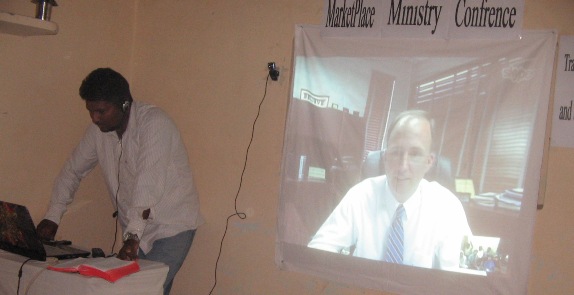
Finally, the day came and the conference went without a hitch…that is if you ignore the 20+ times our internet connection failed! Even so, it really did go smoothly. We were prepared for the hiccups and God paved the way for a smooth presentation (with Rajeev translating). It was truly a remarkable experience.

Christian business conference

Audience in India in prayer.

I cannot explain the excitement that was pulsing through me as I sat in my office in Georgia watching a group almost 8,000 miles away in India sit attentively listening to what I had to say about running a Christian business. The teaching lasted three hours straight (1.5 hours of material and the same amount of time spent in translating!). They never took a break, but sat quietly on the floor soaking it up.

Future Opportunities?

They ended the session with a couple of questions, including the request for further teaching. Rajeev also has another church or two that wants to do the same session in their nearby churches! I honestly do not have any idea where this is headed. Nor do I need to! I am much more inclined to just trust God at this point and see where He takes it!

My Take Aways

Here are some take aways I have from this experience:

  1. Don’t underestimate God. He can do more than I can imagine. (Ephesians 3:20-21)
  2. These things do not depend on my ability, but on His will. (Proverbs 21:31)
  3. Learn and grow as I wait on Him. He will use the knowledge I gain. (Psalm 37:34)
  4. Moses did not get off the hook just because he felt unqualified. (Exodus 4:1-13)
  5. Be faithful in the small things and He will give me bigger ones. (Matthew 25:21)
  6. Relax and trust Him. Worrying is not productive. (Matthew 6:27)

What is God preparing you to do?

Are you being patiently faithful?

Do you see a take away I missed?

Why You May Not Like Tim Tebow!

I had the opportunity to attend the live event for the Chick-Fil-A Leadercast this past Friday. It was a fantastic chance to turn off my work mind for a day and learn from proven leaders. With a slate of 12 or more speakers, it was also easy to find plenty of leadership material for this blog. One of the first items that stood out came from Coach Urban Meyer, former Florida Gators football coach. He finally answered the question I have had for years – Why do so many people dislike Tim Tebow?

Tebow

Tebow Is Clear About His Faith

If you follow sports at all, you clearly know of Tim Tebow. If you know of Tim Tebow, then you also know about his faith in Jesus Christ. You see, Tebow is open and up front about what he believes. His banner is clear. There is no question about where he stands on the issue of his faith.

You may not agree on his skill as a quarterback. Actually, Tebow is not concerned about that. He will tell you straight up that he is not concerned with his recognition as a great quarterback. No, his main concern is that you know where he stands with Jesus.

Is Tebow Too Vocal?

This is the very problem, some people will say. They say that he is too vocal. Many believe that Tebow should quiet down about his faith and just let his play on the football field do the talking. In fact, many Christians believe we should all keep our faith to ourselves, that it is a private matter. If we will just do this, they say, there will be more peace and tolerance.

Let’s put that argument on hold for a moment and get back to Coach Urban Meyer’s answer to the question, “Why do so many people dislike Tim Tebow?” When asked this question by Soledad O’Brien, CNN journalist, Coach Meyer responded insightfully. In fact, his answer makes total sense to me.

Urban Meyer Tells Why

Meyer first talked about his respect for Tim Tebow and the kind of man he is. He explained how Tebow had taught him more in their four years together than Meyer had learned in the 44 years prior! Finally, Meyer answered O’Brien’s question.

Meyer said Tebow is the kind of man that forces people to look inward, to self-evaluate.

Think about that. That statement says volumes! In fact, it is almost an exact match, in meaning, to a quote from Jim Elliot that I shared with you several days earlier! Look at this quote from Elliot’s prayer journal again…

Father, make of me a crisis man. Bring those I contact to decision. Let me not be a milepost on a single road; make me a fork, that men must turn one way or another on facing Christ in me.

Tim Tebow Is A Crisis Man

I don’t know about you, but I cannot get that quote out of my head. When I heard Meyer’s answer, this quote was the first thing that popped into my mind. It is clear to me that Tim Tebow is a “crisis man.” Whether he is familiar with this quote from Jim Elliot or not, I am betting that he has prayed a similar prayer. If so, God has clearly answered it.

For me, there are two take-aways from this post.

Take Away #1

The first is that too many people are uncomfortable with looking inward and self-evaluation. When forced to do so by people like Tim Tebow, they get frustrated, even angry. Unfortunately, this group of people includes Christians and non-Christians alike! This simply should not be so!

I think we should all commit to looking inwardly and self-evaluating on a regular basis. Just like the Psalmist, we should ask God to help us with this (Psalm 139:23-24). We cannot grow in our conforming to the likeness of Christ without doing this!

Take Away #2

The second take away is that I think we are all commanded to shine our lights. Scripture is clear that we are the light and this light is not to be hidden (Matthew 5:14-16). I am not recommending a run on bullhorns at the local sporting goods store! I am, however, suggesting that we all step up our game when it comes to raising our banner. Silence is not an option.

Are you willing to be a “crisis” man or woman?

How are you shining your light in your work?

If hidden, when are you going to uncover your light?